
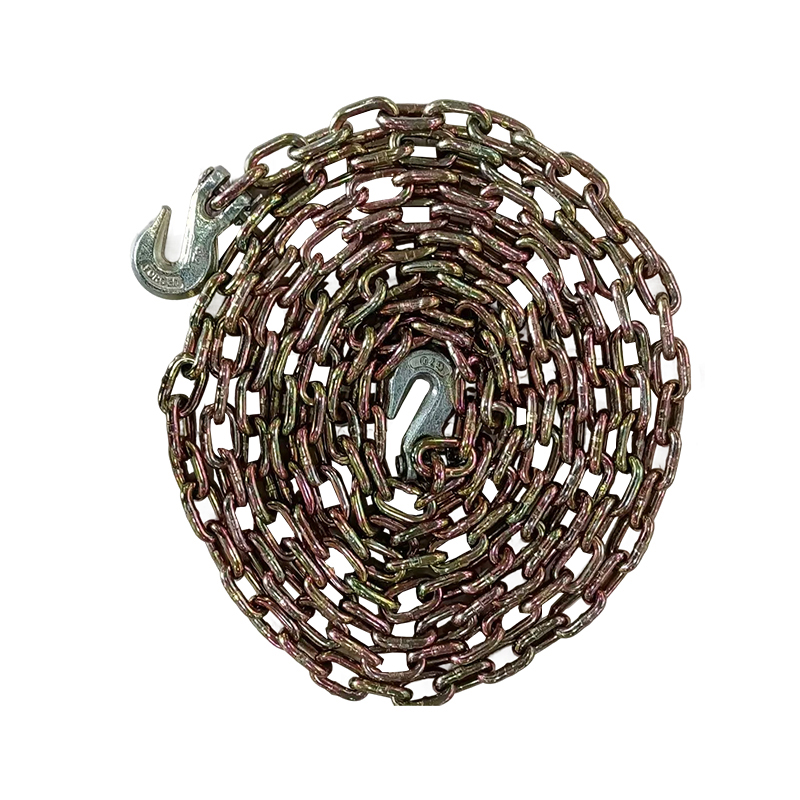
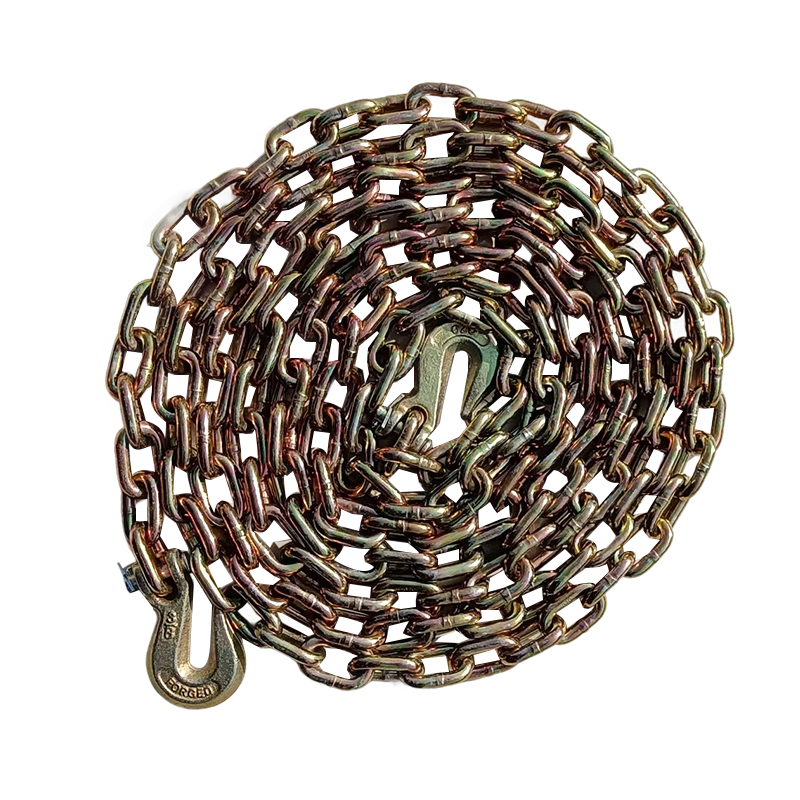
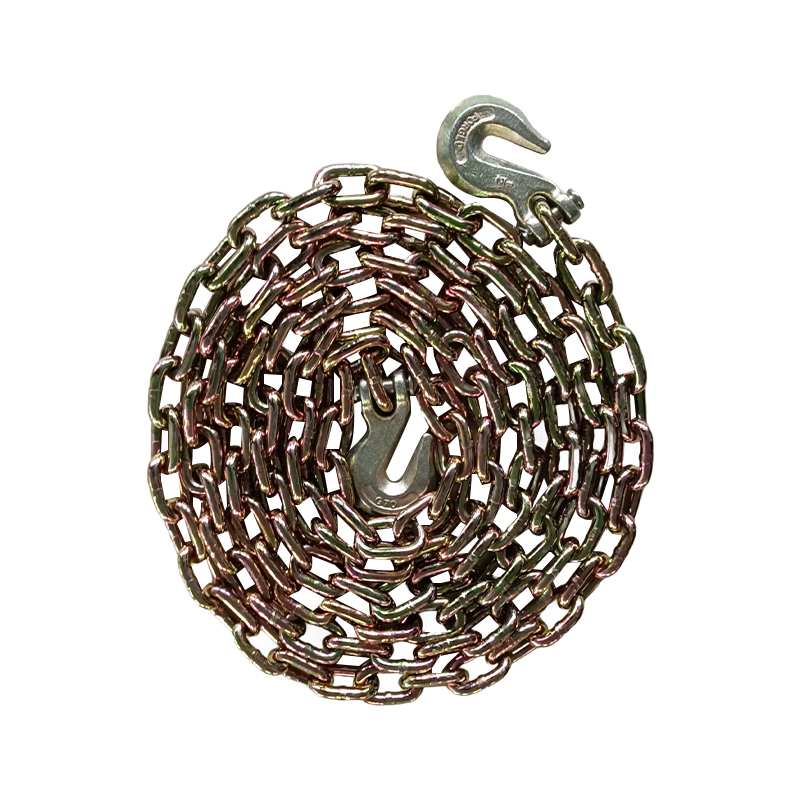



How can a bundling chain maintain zero damage to cargo surfaces under high tensile stress?
Release Time : 2026-01-14
In heavy logistics, engineering machinery transportation, ship deck securing, and large equipment hoisting scenarios, the bundling chain, as a critical fastening tool, bears the important responsibility of resisting turbulence, impact, and inertial forces. It must possess extremely high tensile strength to ensure cargo stability, while simultaneously preventing scratches or damage to the surfaces of high-value or high-precision goods—such as precision instrument housings, car bodies, stainless steel tanks, or aerospace components—due to rigid contact. This seemingly contradictory requirement is perfectly solved through the synergistic combination of material selection, precision manufacturing, and surface engineering.
1. High-Quality Alloy Steel: The Mechanical Foundation of Strength and Toughness
Bundling chains are typically made of chromium-molybdenum alloy steel. This material, after tempering and heat treatment, combines high strength with good toughness. High strength means that thinner links can be used under the same load, reducing the contact area; while sufficient toughness prevents the chain from breaking brittlely or developing burrs under impact loads. More importantly, alloy steel itself has a dense structure and uniform grains, providing an ideal base for subsequent surface finishing and eliminating the risk of scratches caused by material defects from the outset.
2. Special Link Treatment: Mirror-like Contact Interface
The key to truly achieving "zero damage" lies in the meticulous surface treatment of each chain link. First, after heat treatment, the links undergo shot peening to eliminate surface micro-cracks and improve fatigue life. Subsequently, through multiple polishing, tumbling, or vibratory grinding processes, the originally rough casting or forging marks are completely removed. High-end bundled chains even employ mirror polishing technology, controlling the surface roughness Ra value to below 0.8 μm, resulting in a smooth, mirror-like feel. This ultra-smooth surface greatly reduces the coefficient of friction when in contact with goods, preventing scratches from fretting wear or edge scraping even under high tension.
3. Optimized Structural Rounded Corners: Eliminating Stress Concentration Points
In addition to overall smoothness, the geometric design of the chain links is also crucial. Bundling chains feature large-radius rounded transitions at both inner and outer corners to avoid sharp edges. For example, the inner edge of the chain link that directly contacts the goods is CNC-machined into a rounded chamfer of R2–R5mm, effectively dispersing localized pressure and preventing indentations or paint peeling caused by point contact. This "no sharp edges" design ensures that even when bundling high-gloss aluminum, painted steel, or composite material panels, the surface remains intact.
4. Auxiliary Protection Strategies: Flexible Isolation and Intelligent Tensioning
In extremely sensitive scenarios, bundling chains can also be used with flexible sleeves or insulating pads. For example, rubber or polyurethane sleeves can be added at the contact points between the chain and the vehicle body, preserving the chain's high strength while adding a buffer layer. Simultaneously, modern bundling systems often incorporate hydraulic or mechanical tensioners to achieve controllable, gradual pre-tension application, preventing displacement and friction caused by sudden impacts. Operators can also precisely control the tension using torque indicators to ensure bundling is completed within safe load limits, preventing abnormal compression due to overload.
5. Easy to Clean and Maintain: Ensuring Long-Term "Clean Contact"
Bundling chains inevitably accumulate oil, mud, or salt during use. If not cleaned, these hard particles can act like "micro-sandpaper," abrading goods during transport vibrations. Because of their dense, smooth, and non-porous surface, dirt cannot adhere easily; a simple rinse with water or wipe with a soft cloth restores their cleanliness. This ease of maintenance ensures they maintain their initial "zero-damage" performance even after multiple cycles of use.
The balance between high strength and zero damage in bundling chains exemplifies the "rigid-flexible" philosophy in industrial design. They protect transport safety with their steel body, yet delicately safeguard the dignity of goods with their refined surface. From material metallurgy to surface finishing, from structural optimization to usage specifications, every step embodies a dual pursuit of "reliability" and "respect"—respecting both physical limits and the value of what is being protected. This is the core reason why high-end bundling chains surpass ordinary fasteners.
1. High-Quality Alloy Steel: The Mechanical Foundation of Strength and Toughness
Bundling chains are typically made of chromium-molybdenum alloy steel. This material, after tempering and heat treatment, combines high strength with good toughness. High strength means that thinner links can be used under the same load, reducing the contact area; while sufficient toughness prevents the chain from breaking brittlely or developing burrs under impact loads. More importantly, alloy steel itself has a dense structure and uniform grains, providing an ideal base for subsequent surface finishing and eliminating the risk of scratches caused by material defects from the outset.
2. Special Link Treatment: Mirror-like Contact Interface
The key to truly achieving "zero damage" lies in the meticulous surface treatment of each chain link. First, after heat treatment, the links undergo shot peening to eliminate surface micro-cracks and improve fatigue life. Subsequently, through multiple polishing, tumbling, or vibratory grinding processes, the originally rough casting or forging marks are completely removed. High-end bundled chains even employ mirror polishing technology, controlling the surface roughness Ra value to below 0.8 μm, resulting in a smooth, mirror-like feel. This ultra-smooth surface greatly reduces the coefficient of friction when in contact with goods, preventing scratches from fretting wear or edge scraping even under high tension.
3. Optimized Structural Rounded Corners: Eliminating Stress Concentration Points
In addition to overall smoothness, the geometric design of the chain links is also crucial. Bundling chains feature large-radius rounded transitions at both inner and outer corners to avoid sharp edges. For example, the inner edge of the chain link that directly contacts the goods is CNC-machined into a rounded chamfer of R2–R5mm, effectively dispersing localized pressure and preventing indentations or paint peeling caused by point contact. This "no sharp edges" design ensures that even when bundling high-gloss aluminum, painted steel, or composite material panels, the surface remains intact.
4. Auxiliary Protection Strategies: Flexible Isolation and Intelligent Tensioning
In extremely sensitive scenarios, bundling chains can also be used with flexible sleeves or insulating pads. For example, rubber or polyurethane sleeves can be added at the contact points between the chain and the vehicle body, preserving the chain's high strength while adding a buffer layer. Simultaneously, modern bundling systems often incorporate hydraulic or mechanical tensioners to achieve controllable, gradual pre-tension application, preventing displacement and friction caused by sudden impacts. Operators can also precisely control the tension using torque indicators to ensure bundling is completed within safe load limits, preventing abnormal compression due to overload.
5. Easy to Clean and Maintain: Ensuring Long-Term "Clean Contact"
Bundling chains inevitably accumulate oil, mud, or salt during use. If not cleaned, these hard particles can act like "micro-sandpaper," abrading goods during transport vibrations. Because of their dense, smooth, and non-porous surface, dirt cannot adhere easily; a simple rinse with water or wipe with a soft cloth restores their cleanliness. This ease of maintenance ensures they maintain their initial "zero-damage" performance even after multiple cycles of use.
The balance between high strength and zero damage in bundling chains exemplifies the "rigid-flexible" philosophy in industrial design. They protect transport safety with their steel body, yet delicately safeguard the dignity of goods with their refined surface. From material metallurgy to surface finishing, from structural optimization to usage specifications, every step embodies a dual pursuit of "reliability" and "respect"—respecting both physical limits and the value of what is being protected. This is the core reason why high-end bundling chains surpass ordinary fasteners.